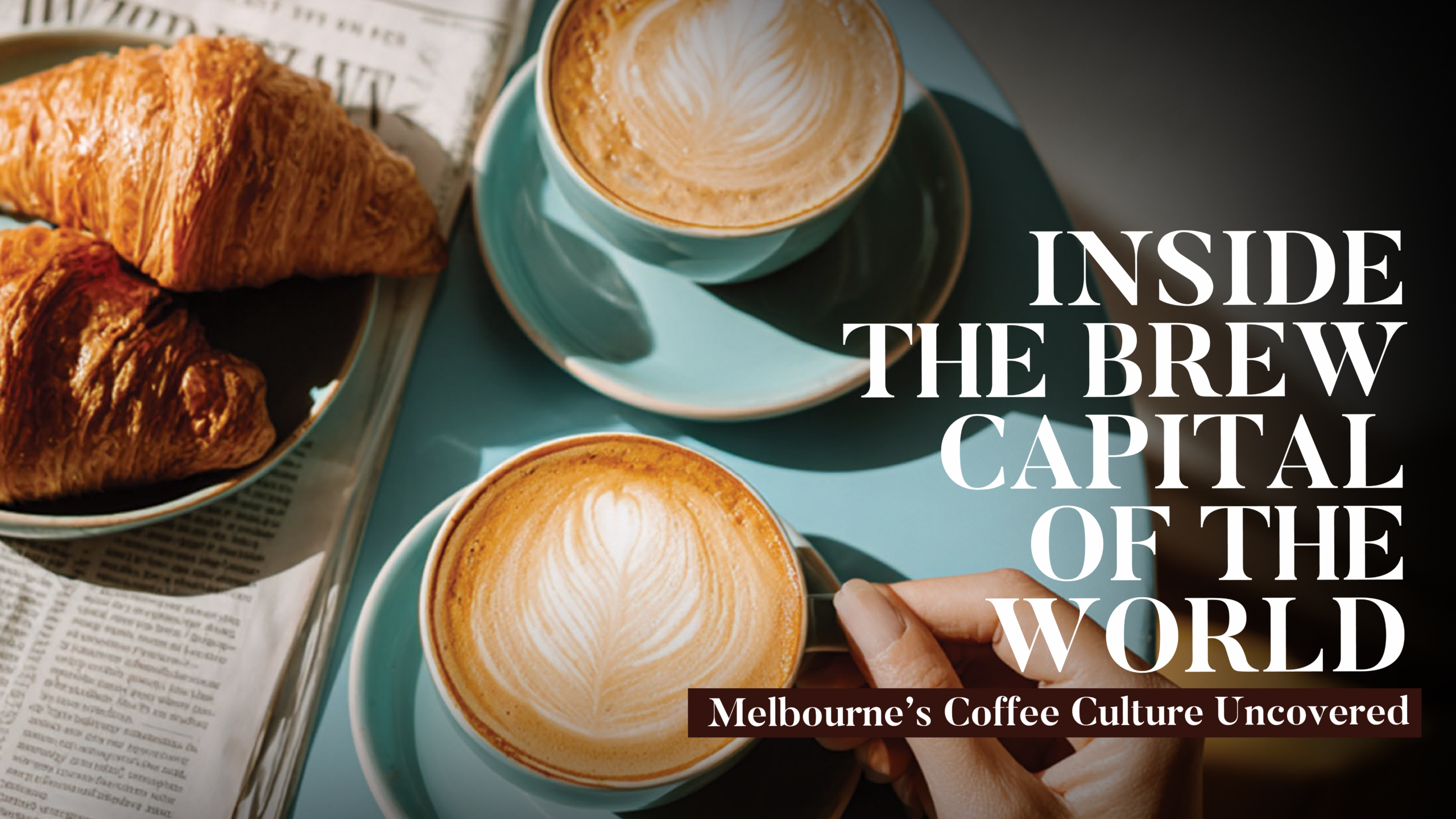

There is a certain way Melbourne breathes in the morning. As dawn unfolds across its tangle of cobblestone laneways, the city doesn’t stir so much as bloom, slowly, warmly, fragrantly. The scent of freshly ground beans drifts through narrow streets like an unofficial anthem. Espresso machines hiss in rhythmic intervals, baristas greet early risers by name, and sunlight glints off the brass handles of well-loved La Marzocco machines.
In Melbourne, coffee is not just a drink, it is a ritual, a conversation, a citywide choreography performed with quiet passion.
This deep, daily devotion is precisely why Melbourne has earned its now-worldwide reputation as the brew capital of the world, a title not granted lightly, but one shaped through decades of migration, craft, innovation, and an unwavering cultural love for the perfect cup.
Melbourne’s love affair with coffee is rooted in a story of movement and belonging. After World War II, waves of Italian and Greek immigrants arrived in Australia, carrying with them not only hopes for a new life but a vibrant café tradition. They brought espresso machines, heavy, chrome monuments of comfort, into small corner shops and neighborhood bars.
These first cafés became melting pots of languages, aromas, and identities. Melburnians tasted espresso for the first time, heard stories from new arrivals, and found themselves falling into the rhythm of European coffee culture. The city’s café identity was born at these tables, tables that served as sanctuaries, meeting points, and cultural classrooms.
By the 1980s and 1990s, Australia’s flexible hospitality regulations and growing foodie culture allowed cafés to flourish. Chains never truly took hold. Melbourne wanted independence, character, experimentation and that desire created a café ecosystem unlike anything in the rest of the English-speaking world.
To understand Melbourne’s claim as the brew capital, one must look at its distinct “Melbourne style,” an approach to coffee that blends scientific precision with soulful artistry. Step inside any well-known café and you’ll see the ritual unfold:
• Baristas adjusting grinders by the gram,
• Tasting espresso before serving it,
• Pouring milk in quiet, almost meditative motions,
• Sharing stories about origin farms as naturally as discussing the weather.
Cafés are small, intimate, and fiercely independent. Interiors lean toward minimalist Scandinavian or industrial chic, timber, exposed brick, soft lighting, creating a space where coffee feels elevated yet accessible.
But perhaps the most defining element is the roast. Melbourne’s specialty roasters, Market Lane, Seven Seeds, St. Ali, Proud Mary, Industry Beans, and many others, sparked a revolution by prioritizing single-origin beans, direct trade, and micro-roasting techniques that highlight each bean’s unique profile. Their influence spread internationally, shaping a global movement often referred to as the “third wave” of coffee.
Today, coffee shops from Brooklyn to Berlin proudly claim to be “Melbourne-inspired,” a testament to how a local tradition became a global reference point.
If one beverage encapsulates Melbourne’s identity, it is the flat white, a silky espresso-based drink topped with microfoamed milk that creates an almost velvety texture.
Its origin is shared between Australia and New Zealand, but Melbourne’s mastery of the flat white is undisputed. Here, the flat white is treated as a canvas for baristas:
• The espresso must be rich yet balanced.
• The milk must be textured, not frothy.
• The pour must feel like a dance.
To taste a flat white in Melbourne is to experience the city’s philosophy: simplicity, elevated.
Melbourne’s café culture is not centralized. It spreads across neighbourhoods, each contributing its own voice to the city’s coffee identity.
Fitzroy & Collingwood:
The creative heart. Once industrial districts, now home to warehouses turned roasteries, coffee labs, and experimental menus. If innovation had an address, it would begin here.
Carlton:
The historic home of Melbourne’s Italian community. Espresso bars, European bakeries, and cafés that nod to mid-century Melbourne coexist with new specialty spots, creating a charming blend of old and new.
St Kilda:
Beachfront cafés with breezy mornings, pastries, and robust brews. The perfect intersection of seaside calm and inner-city craft.
CBD Laneways:
Perhaps the most photographed coffee streets in the world, Hosier Lane, Degraves Street, Hardware Lane. Here, cafés opened in old service alleys are now global icons.
In Melbourne, coffee is a map. Each cup marks a different neighbourhood, each neighbourhood offers a different mood.
Melbourne doesn’t just make great coffee; it teaches the world how to make great coffee.
The city hosts Melbourne Coffee Week and the Melbourne International Coffee Expo (MICE), the two major events that attract roasters, baristas, equipment manufacturers, exporters, and coffee enthusiasts from around the globe. These gatherings are more than exhibitions; they are incubators of innovation where techniques are exchanged, debates are sparked, and global standards are reshaped.
Melbourne’s influence can be traced in the rise of filter coffee in East Asia, micro-roasteries in the U.S., minimalist café aesthetics in Europe, sustainability-driven procurement across the world. The city sets trends, not by following competition, but by nurturing community.
One of Melbourne’s most impressive contributions to global coffee culture is its commitment to ethical sourcing.
Specialty roasters here have championed direct trade, paying farmers above-market premiums, supporting community development at origin, and ensuring transparency from farm to cup. Sustainability efforts include energy-efficient roasters, compostable coffee bags, reusable cup programs, and education around climate challenges facing coffee-growing regions.
Consumers in Melbourne, curious, informed, and environmentally conscious, expect cafés to know their supply chain intimately. As a result, roasters often share stories of growers, regions, and harvest methods not as marketing but as part of the culture.
To visit Melbourne is to embark on a curated coffee journey.
A day might look like this:
• Start in Flinders Lane with a smooth flat white.
• Wander to Fitzroy for a cupping session at a roastery.
• Pause for a pour-over flight in Collingwood.
• Enjoy an afternoon espresso by the sea in St Kilda.
• End the day in a tucked-away CBD café with a barista who explains the difference between washed and natural processing.
Melbourne rewards curiosity. Each cup teaches something new, about craft, taste, or the journey beans take from distant farms to your hands.
What makes Melbourne truly special is its ability to innovate without losing its sense of self. New cafés open constantly. Young roasters experiment with fermentation. Baristas compete on global stages. Trends come and go, but the essence remains, Coffee is a community.
It is connection, creativity, craftsmanship and above all, culture. Melbourne isn’t just a place where coffee is consumed. It is a city where coffee is used.
For a global audience, this is Melbourne’s gift: a reminder that some of the world’s most meaningful experiences are often found in the quiet warmth of a morning cup.