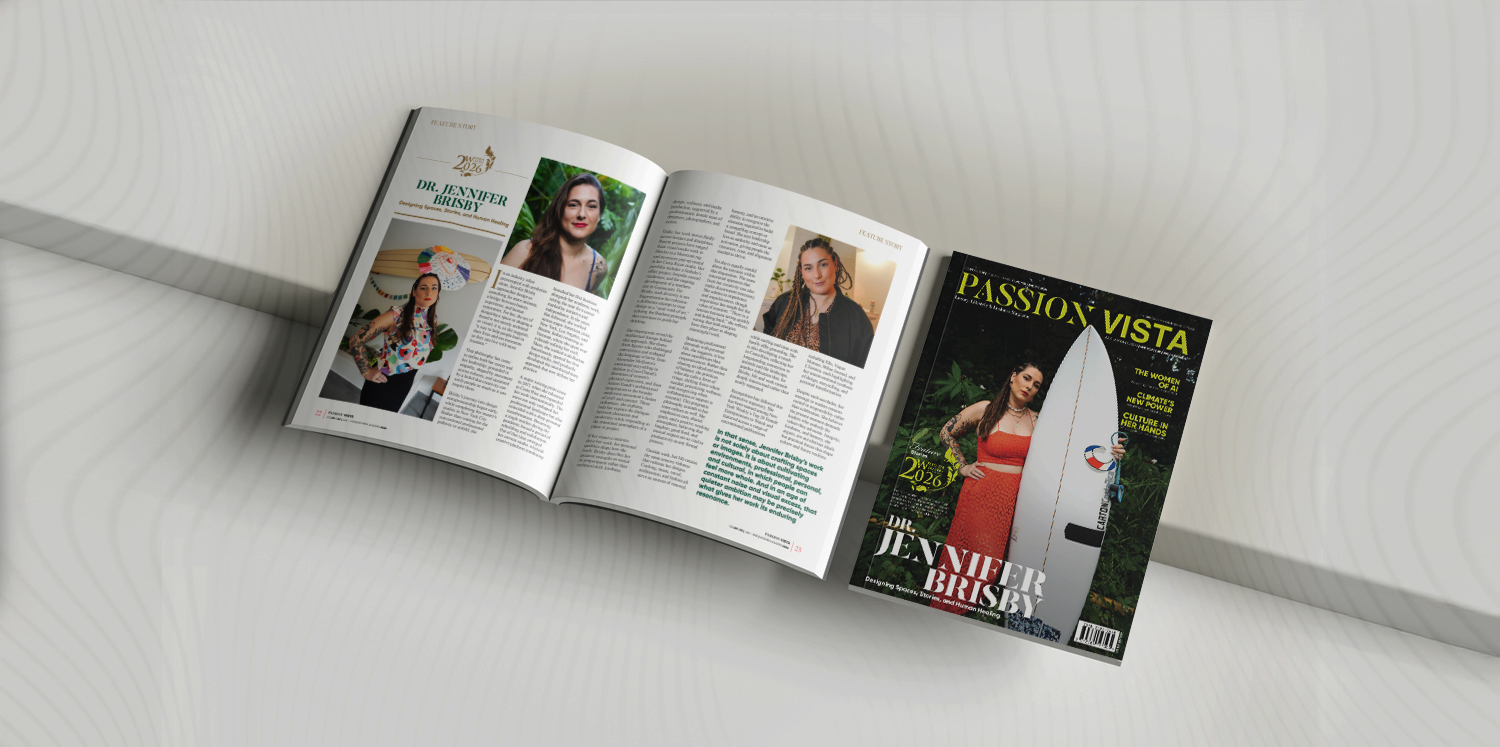

In an industry often preoccupied with aesthetics alone, Jennifer Brisby approaches design as something far more intimate, a bridge between beauty, experience, and human restoration. For her, the act of designing a space or shaping a brand is not merely technical or visual; it is, as she suggests, “a way to help people heal in their lives and environments so they can live with more freedom.”
That philosophy has come to define both her career and her leadership: grounded in empathy, shaped by movement across cultures, and sustained by a belief that creativity can unify people as much as it can inspire them.
Brisby’s journey into design entrepreneurship began early, while completing her master’s studies in New York City. Rather than waiting for the conventional professional pathway to unfold, she launched her first business alongside her academic work, setting the tone for a career marked by initiative and independence. In the years that followed, she worked across major American cities, New York, Los Angeles, and Boston, before returning to Vermont, where she spent over a decade refining her craft. There, she worked with Burton Snowboards, opened her first design studio, and gradually developed the interdisciplinary approach that now defines her practice.
A major turning point came in 2017, when she relocated to Costa Rica and expanded her work internationally. The move not only reshaped her professional landscape but also coincided with a deep personal transformation. Becoming a single mother during the pandemic forced a period of rebuilding and redefinition. Out of that time emerged her current studio, a hybrid creative platform combining design, wellness, and media production, supported by a predominantly female team of designers, photographers, and artists.
Today, her work moves fluidly across borders and disciplines. Recent projects have ranged from visual media work in Mexico to a Moroccan rug and accessory pop-up rooted in her Costa Rican studio. Her portfolio includes a Sotheby’s office project, bespoke coastal residences, and the ongoing development of a ranchero site in Guanacaste. For Brisby, such diversity is not fragmentation but cohesion: a deliberate attempt to treat design as a “total work of art,” echoing the Bauhaus principle that continues to guide her thinking.
Her inspirations reveal the intellectual lineage behind this approach. She draws from figures who challenged conventions and reshaped the language of form, from Alexander McQueen’s emotional storytelling in fashion to Coco Chanel’s liberation of women’s physical expression, and from Antoni Gaudí’s architectural imagination to the broader modernist movement’s fusion of craft and concept. These influences, she explains, help her explore the dialogue between classicism and modernity while responding to the emotional atmosphere of a place or project.
If her creative instincts drive her work, her personal qualities shape how she leads. Brisby describes her greatest strengths as rooted in temperament rather than technical skill: kindness, honesty, and an intuitive ability to recognize the elements required to build a compelling concept or brand. She sees leadership less as authority and more as activation, giving people the resources, trust, and alignment needed to thrive.
Yet she is equally candid about the tensions within that disposition. The same emotional openness that fuels her creativity can also make discernment necessary. She admits to impatience and impulsiveness, though experience has taught her the value of restraint. “There is a tension between acting quickly and holding back,” she reflects, noting that both energies have their place in shaping meaningful work.
Balancing professional demands with personal life, she suggests, is less about equilibrium than responsiveness. Rather than chasing an idealized notion of balance, she practices what she calls a form of triage, shifting focus where needed, prioritizing wellness, and recognizing when collaboration or support is essential. This pragmatic philosophy extends to her team culture as well. She emphasizes care, shared goals, and a positive working atmosphere, believing that laughter, good food, and mutual respect are as vital to productivity as any formal process.
Outside work, her life retains the same sensory richness that informs her designs. Cooking, music, travel, architecture, and fashion all serve as sources of renewal, while surfing and time with family offer grounding. She is also developing a ranch in Costa Rica, reflecting her longstanding connection to animals and the landscape, another indication that, for Brisby, life and work remain deeply intertwined rather than neatly separated.
Recognition has followed this distinctive trajectory. She has been named among New York Weekly’s Top 20 Female Entrepreneurs to Watch and featured across a range of international publications including Elle, Vogue Monaco, Milan Journal, and L’Iconica, each highlighting her unconventional synthesis of design, storytelling, and personal transformation.
Despite such accolades, her message to readers remains rooted in responsibility rather than celebration. She believes the present moment demands leaders who embody the values they advocate. Integrity, kindness, and honesty, she argues, are not abstract ideals but practical forces that shape culture and future realities.
In that sense, Jennifer Brisby’s work is not solely about crafting spaces or images. It is about cultivating environments, professional, personal, and cultural, in which people can feel more whole. And in an age of constant noise and visual excess, that quieter ambition may be precisely what gives her work its enduring resonance.