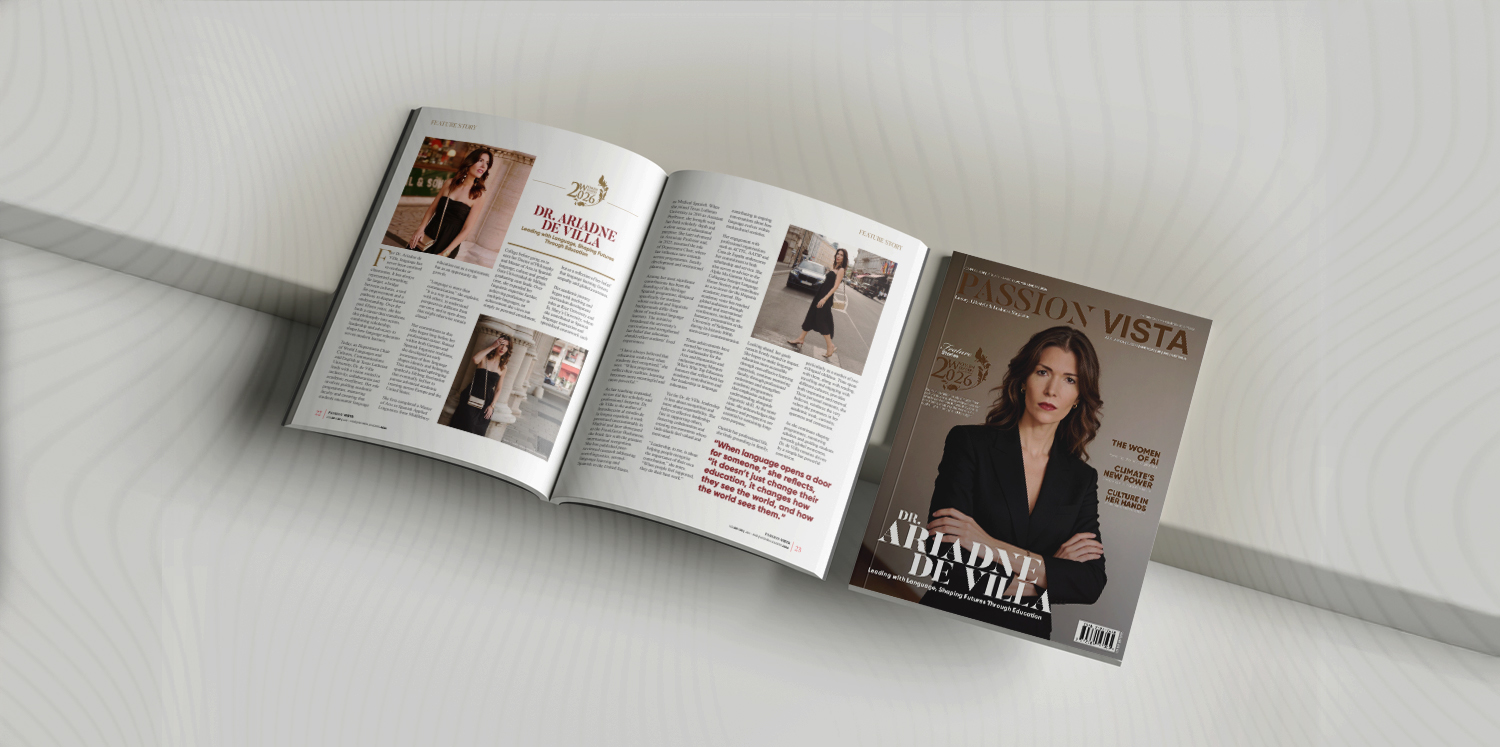

For Dr. Ariadne de Villa, language has never been confined to textbooks or classrooms. It has always represented something far larger, a bridge between cultures, a tool for empowerment and a pathway to deeper human understanding. Over the past fifteen years, she has built a career that transforms this philosophy into action, combining scholarship, leadership and advocacy to shape how language education serves modern learners.
Today, as Department Chair of World Languages and Cultures, Communications and English at Texas Lutheran University, Dr. de Villa leads with a vision rooted in inclusivity, collaboration and academic excellence. Her role involves guiding academic programmes, mentoring faculty and ensuring that students encounter language education not as a requirement, but as an opportunity for growth.
“Language is more than communication,” she explains. “It is a way to connect with others, to understand perspectives different from our own, and to open doors that might otherwise remain closed.”
Her commitment to this idea began long before her professional career. Raised within both German and Spanish linguistic traditions, she developed an early awareness of how language shapes identity and belonging. This multilingual upbringing sparked a lifelong fascination that eventually led her to pursue advanced academic training across Europe and the United States.
She first completed a Master of Arts in Spanish Applied Linguistics from Middlebury College before going on to earn her Doctor of Philosophy and Master of Arts in Spanish language, culture and gender from Universidad de Málaga, graduating cum laude. Over time, she expanded her linguistic expertise further, achieving proficiency in multiple languages, an achievement she views not simply as personal enrichment, but as a reflection of her belief that language learning fosters empathy and global awareness.
Her academic journey began with teaching and curriculum development roles at Rice University and St. Mary’s University, where she contributed to Spanish language instruction and specialised coursework such as Medical Spanish. When she joined Texas Lutheran University in 2016 as Assistant Professor, she brought with her both scholarly depth and a clear sense of educational purpose. She later advanced to Associate Professor and, in 2025, assumed the role of Department Chair, where her influence now extends across programmes, faculty development and institutional planning.
Among her most significant contributions has been the founding of the Heritage Spanish programme, designed specifically for students whose cultural and linguistic backgrounds differ from those of traditional language learners. The initiative broadened the university’s curriculum and strengthened her belief that education should reflect students’ lived experiences.
“I have always believed that education works best when students feel recognised,” she says. “When programmes reflect their realities, learning becomes more meaningful and more powerful.”
As her teaching expanded, so too did her scholarly and professional footprint. Dr. de Villa is the author of Introducción al estudio de la lengua española, a work presented internationally in Madrid and later showcased at the Frankfurter Buchmesse, the book fair with the greatest international recognition. She has published peer-reviewed research addressing sociolinguistics, second-language learning and Spanish in the United States, contributing to ongoing conversations about how language evolves within multicultural societies.
Her engagement with professional organisations such as ACTFL, AATSP and Casa de España underscores her commitment to both scholarship and service. She also serves as adviser to the Alpha Mu Gamma National Collegiate Foreign Language Honor Society and contributes as a reviewer for the Hispania academic journal. Her academic voice has reached global audiences through national and international conferences, including an honorary presentation at the University of Salamanca during its historic 800th anniversary commemoration.
These achievements have earned her recognition as Ambassador for the Arts and Humanities and inclusion among Marquis Who’s Who Top Educators honours that reflect both her academic contributions and her leadership in language education.
Yet for Dr. de Villa, leadership is less about recognition and more about responsibility. She believes effective leadership lies in supporting others, fostering collaboration and creating environments where individuals feel valued and motivated.
“Leadership, to me, is about helping people recognise the importance of their own contribution,” she notes. “When people feel supported, they do their best work.”
Looking ahead, her goals remain firmly rooted in impact. She hopes to make language education more accessible through cost-effective learning materials, continue mentoring faculty through professional milestones and strengthen academic programmes that emphasise cultural understanding alongside linguistic skill. At the same time, she acknowledges that balance and perspective are essential to sustaining long-term purpose.
Outside her professional life, she finds grounding in family, particularly as a mother of two trilingual children. Time spent with them, along with reading, travelling and engaging with different cultures, provides both inspiration and renewal. These personal moments, she believes, reinforce the very values she promotes in her academic work, curiosity, openness and connection.
As she continues shaping programmes, mentoring scholars and guiding students towards global awareness, Dr. de Villa remains driven by a simple but powerful conviction.
“When language opens a door for someone,” she reflects, “it doesn’t just change their education, it changes how they see the world, and how the world sees them.”