
Leadership often emerges in the most unexpected landscapes. For some women it is forged in boardrooms, for others in laboratories or political assemblies, but for Parbati Barua, one of India’s most extraordinary wildlife conservationists, leadership was shaped in the forests of Assam where elephants move with quiet majesty and ancient ecosystems thrive far from modern civilisation.
Born on 14 March 1953 in Gauripur in Assam’s Dhubri district, Parbati Barua belonged to the royal family of Gauripur, a lineage deeply connected with the forests and wildlife of the region. Her father, Prakritish Chandra Barua, the last Rajah of Gauripur, was internationally respected for his knowledge of elephants and widely regarded as one of India’s foremost elephant experts. The royal household once maintained nearly forty elephants, and caring for them formed an integral part of life within the Barua estate.
For the young Parbati, childhood unfolded not within palace walls but in the vast landscapes of the forest. Her father frequently travelled on expeditions into Assam’s wilderness, journeys that became formative experiences as she quietly observed the behaviour and intelligence of elephants. What began as fascination gradually developed into a rare instinctive understanding of these majestic animals.
The Fourteen-Year-Old Who Captured Her First Elephant
The defining moment that revealed Parbati Barua’s extraordinary destiny arrived when she was only fourteen years old. During an expedition in the Kochugaon forests of Assam, she successfully captured and domesticated her first wild elephant, astonishing seasoned elephant handlers and revealing her remarkable ability to communicate with animals that many people feared.
This early achievement marked the beginning of a life devoted to elephants, yet her journey unfolded during a period of change for India’s princely families. In 1970, the abolition of the privy purse system ended the financial privileges that had supported royal households across the country.
For Parbati and her father, the forests that had once been the setting for royal expeditions became the foundation of their livelihood. Returning to the jungles with renewed purpose, they dedicated themselves to elephant training and wildlife management. It was during this time that Parbati Barua formally began her professional journey as a mahout, the traditional elephant handler whose life revolves around understanding and caring for elephants.
Breaking Barriers in a World Reserved for Men
The profession of a mahout has historically been dominated by men and requires courage, endurance, and years of close companionship with elephants. For generations it was considered unsuitable for women.
Yet Parbati Barua quietly challenged this assumption and gradually became recognised as India’s first female elephant mahout, stepping into a profession where few women had ever ventured. Her work involved mastering traditional techniques of elephant handling practised for centuries across the forests of Northeast India.
Among these methods was Mela Shikar, a traditional system used to capture wild elephants without tranquiliser guns. Skilled mahouts mounted on trained elephants known as koonki would approach wild herds and guide them into captivity using ropes, patience, and deep understanding of elephant behaviour. Although wildlife conservation laws have since restricted such practices, they once played an important role in forest management.
Through years of dedication and experience, Parbati Barua mastered these techniques with remarkable expertise, earning the respect of forest officials and local communities.
The Woman Who Tamed Hundreds of Giants
Across a career spanning more than five decades, Parbati Barua has trained and domesticated more than five hundred elephants, an achievement that places her among the most experienced elephant handlers in India.
Her expertise has been sought by forest departments across several states including Assam, West Bengal, Odisha, Kerala, Uttarakhand and Uttar Pradesh, particularly in situations where wild elephants have wandered into villages or agricultural lands.
Those who know her affectionately refer to her as “Hasti Kanya,” meaning the Elephant Girl, a name that reflects her lifelong bond with elephants and the courage with which she built her career.
When the Forest Found Its Ambassador
As Parbati Barua’s reputation grew, her knowledge attracted attention beyond the forests of Assam. Conservationists recognised that her experience represented a bridge between traditional forest wisdom and modern wildlife science.
She later became associated with the Asian Elephant Specialist Group of the International Union for Conservation of Nature, contributing her insights to global conservation discussions. Her work received international recognition in 1989, when the United Nations Environment Programme honoured her with the Global 500 Roll of Honour for her contribution to environmental protection.
In 2003, the Government of Assam appointed her Honorary Chief Elephant Warden of Assam, acknowledging her dedication to elephant conservation and wildlife protection.
Her story also reached global audiences through the BBC documentary “Queen of the Elephants,” and writings by conservationist Mark Shand, which introduced her extraordinary journey to readers and viewers around the world.
A Nation Finally Says Thank You
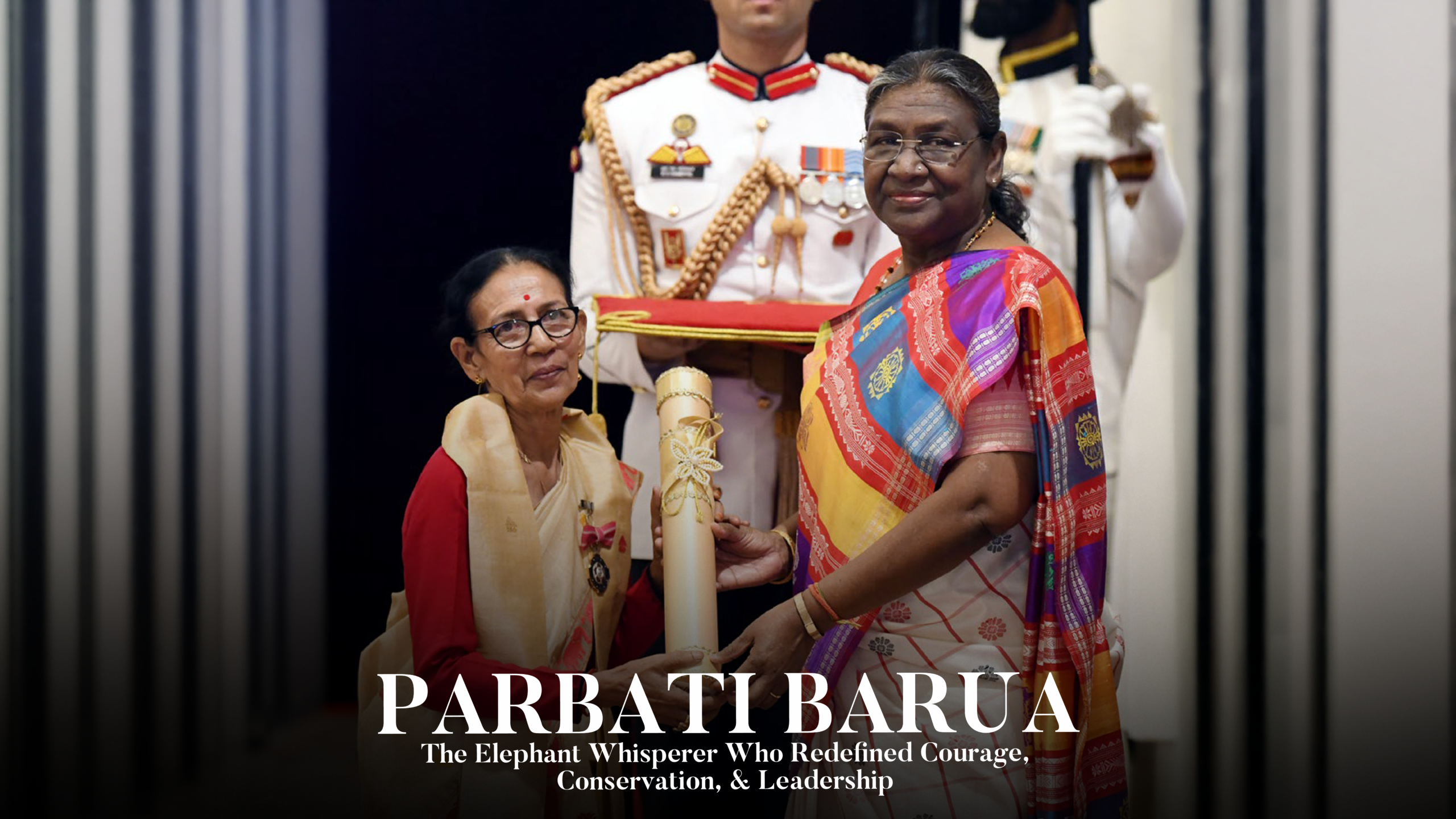
In 2024, Parbati Barua received one of India’s highest civilian honours when President Droupadi Murmu awarded her the Padma Shri, recognising her decades of contribution to wildlife conservation and elephant welfare.
The recognition symbolised national acknowledgement of the traditional knowledge held by forest practitioners whose understanding of wildlife has long helped protect India’s biodiversity.
The Legacy of an Extraordinary Woman
Today, Parbati Barua’s life stands as a testament to courage, compassion, and perseverance. Her journey bridges worlds that rarely intersect, royal heritage and forest survival, ancient tradition and modern conservation science, and human civilisation with the intelligence of elephants.
In an age when leadership is often measured through power or visibility, her story offers a different definition. Leadership, in her case, has meant patience, empathy, and the ability to listen to the silent rhythms of the natural world.
For women across the globe seeking inspiration beyond conventional success stories, Parbati Barua represents the possibility that one individual, guided by passion and courage, can reshape both human understanding and the fragile balance of the natural world.
Long before national honours recognised her achievements, the forests of Assam had already given her a title far more poetic. They simply called her the Queen of the Elephants.