
In the heart of Luckno w’s old city, morning sunlight spills into a narrow courtyard where a group of women sit with soft cotton fabric resting in their laps. Their hands move with effortless rhythm, needle slipping through cloth, forming petals and vines as if guided by memory itself. This is Chikankari, the celebrated embroidery of Awadh. For a moment, the world outside feels distant, drowned out by the quiet concentration of these artisans. And yet, if you step beyond the courtyard walls, you’ll find Chikankari everywhere: on fashion runways, on Instagram boutiques, in global wardrobes hungry for something handmade.
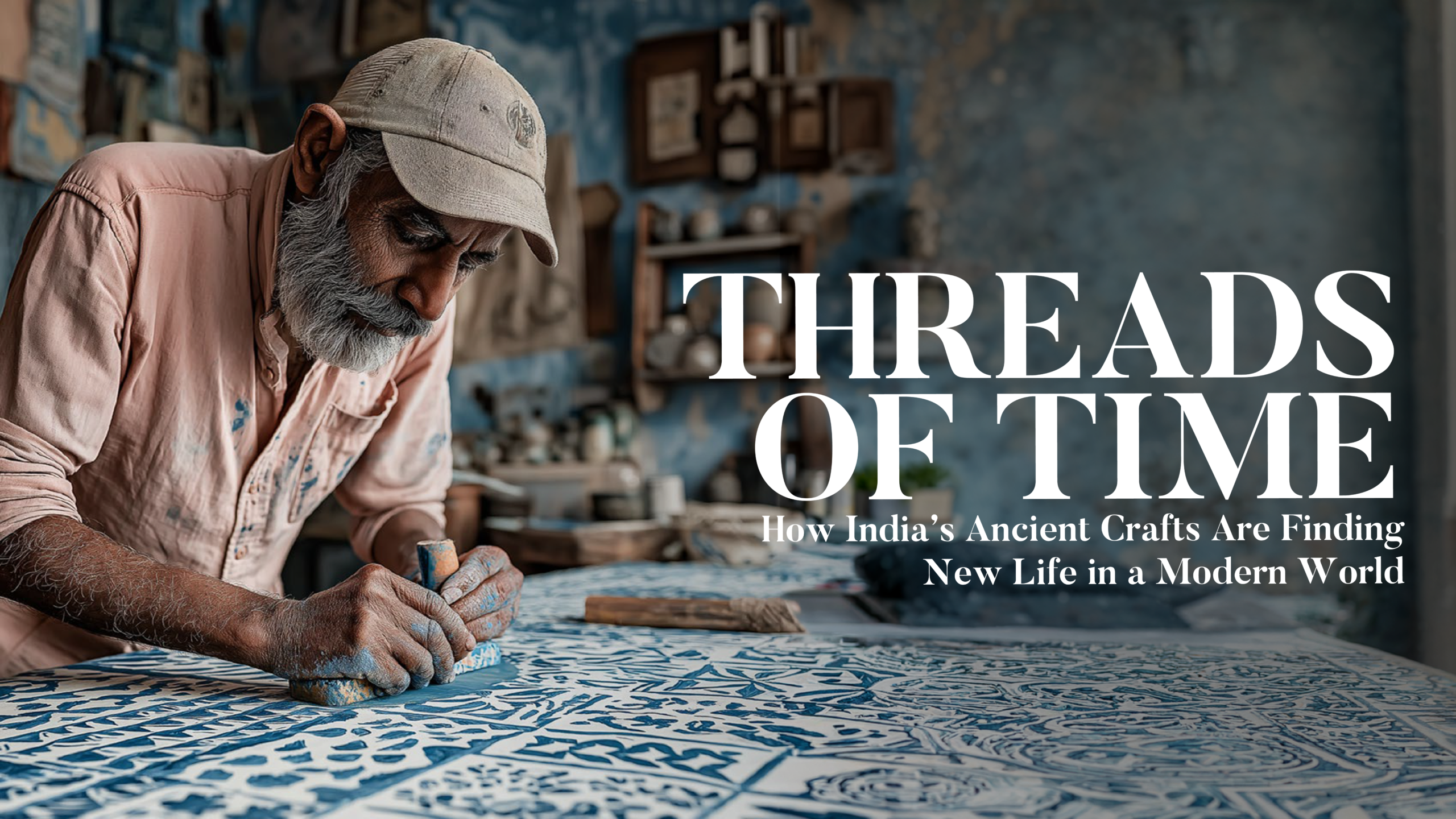
This contrast, timeless craft flourishing in a hyper-modern world, captures the essence of India’s craft revival. Across the country, ancient art forms long overshadowed by industrialisation and fast fashion are experiencing a renaissance. From the luminous blue pottery of Jaipur to the narrative scroll paintings of Odisha and the shimmering brocades of Banaras, India is proving that heritage is not a relic to be preserved behind museum glass but a living, evolving force.
Chikankari:
Few crafts carry the poetry of Chikankari. Born during the Mughal era and refined under the Nawabs, the art once adorned muslin worn by royalty. Over time, however, it began to fade. Cheaper machine-made imitations flooded markets, and younger generations dismissed it as outdated.
What revived it was a blend of design innovation and human resilience. Young fashion designers began reimagining Chikankari in pastel hues, contemporary silhouettes, and trans-seasonal collections. Global celebrities wore it, fashion magazines featured it, and suddenly the delicate handwork of Lucknow found new admirers.
But the most meaningful part of this revival lies with the artisans, mostly women who stitch from home while supporting families. The renewed demand has brought steady income, visibility, and pride. Each garment carries not just embroidery but the story of a craft reclaimed and a community uplifted. In their hands, Chikankari has become more than threadwork; it is quiet empowerment.
Pattachitra:
Travel east to Odisha, and you meet a very different craft, Pattachitra, one of India’s oldest storytelling traditions. Painted on cloth with natural pigments, these scrolls once narrated tales of gods and folklore to village audiences. The art is ornate, almost hypnotic: swirling motifs, expressive figures, intricate borders that require astonishing precision.
For years, Pattachitra remained confined to temple towns and rural markets. But as artists and craft collectives began experimenting with new surfaces, the art form found a vibrant second life. Today, Pattachitra appears on sarees, jackets, décor pieces, stationery, and even footwear. Murals in urban cafés and boutique hotels use it to evoke cultural warmth.
What makes its revival particularly striking is its adaptability. The technique remains rooted in tradition, but the canvas has changed. Younger buyers, fascinated by its mythic energy and handcrafted charm, are giving Pattachitra a place in contemporary living spaces. It shows how an ancient storytelling art can speak fluently to modern eyes.
Banarasi Weaving:
Along the ghats of Varanasi, the rhythmic clatter of handlooms tells a centuries-old story. Banarasi weaving, once one of India’s most luxurious textile traditions, is famed for its gold and silver zari, Mughal-inspired motifs, and regal richness. But in recent decades, the craft struggled. The sarees were considered too heavy, too expensive, too ceremonial for everyday use. Machine-woven imitations and synthetic fabrics threatened the livelihood of thousands of weavers.
Its revival arrived through a renewed design lens. Young designers began reinterpreting Banarasi textiles for modern wardrobes, lighter fabrics, softer colours, minimalist patterns, and silhouettes beyond the saree. Suddenly, Banarasi silk wasn’t just bridal wear; it became everyday luxury.
Digital platforms deepened the transformation. For the first time, a weaver in Varanasi could sell directly to customers across the world, bypassing middlemen who had long eroded profits. With global audiences embracing craft-based clothing and sustainable fashion, Banarasi weaving became a symbol of heritage meeting modernity. Today, its revival is both aesthetic and economic, ensuring the looms continue to hum with life.
Blue Pottery:
Among India’s revived crafts, few are as visually striking as Jaipur Blue Pottery. The first glimpse of it, deep cobalt blues, luminous whites, Persian-inspired florals, is unforgettable. Unlike typical ceramics, Blue Pottery uses no clay; it is made from a unique mix of quartz, powdered glass, and natural materials, fired at low temperatures to achieve its signature sheen.
Despite its beauty, Blue Pottery almost disappeared by the mid-20th century. Lack of awareness, limited markets, and cheaper imitations pushed artisans away from the craft. Its comeback began slowly, through NGOs, design schools, craft activists, and local families who refused to let the tradition die. Workshops reopened, artisans trained apprentices, and designers introduced new forms and colour palettes.
Today, Blue Pottery appears in premium home décor stores around the world. Hotels and restaurants use its tiles and tableware to create striking visual identities. What was once an endangered craft has become a global design trend, a testament to how cultural heritage can reinvent itself without losing its soul.
The renewed interest in India’s crafts is not accidental. It mirrors a global shift toward sustainability, authenticity, and human connection. As fast fashion and factory-made décor dominate markets, consumers are seeking pieces with soul, items made slowly, thoughtfully, and with tradition behind them.
Indian crafts offer exactly that. Each piece carries time, labour, and lineage. Each motif or technique holds cultural memory. The revival also reflects changing attitudes among young Indians, who now wear their heritage proudly, not as a relic, but as fashion-forward identity.
Designers are key bridges in this movement. They translate traditional aesthetics into contemporary forms, helping artisanal crafts fit seamlessly into modern lifestyles. Digital marketplaces amplify the reach, ensuring artisans gain visibility and fair compensation.
But beyond commerce, these revivals tell a deeper story: that in a world racing toward the future, people are longing for something rooted, something that connects them to history, humanity, and home.
India’s craft revival is still a work in progress. Challenges remain: fair wages, ethical production, design innovation, and the need for younger artisans to inherit these skills. But the momentum is strong, and the world is watching.
Somewhere in Lucknow, a woman finishes a Chikankari motif. In Odisha, a young artist paints a modern Pattachitra panel. In Varanasi, a weaver adjusts the warp on an age-old loom. And in Jaipur, a potter lifts a newly fired piece of Blue Pottery, its cobalt hues glowing like a forgotten jewel restored to light.
Together, they are not simply preserving craft, they are shaping its future. And in doing so, they remind us that tradition is not behind us; it is right here, evolving beautifully in human hands.