
There are cities that dazzle you, and then there are cities that soften you. Chiang Mai belongs unmistakably to the latter. Cradled by Thailand’s northern mountains and shaped by centuries of Lanna Buddhist tradition, this historic city has long been a refuge for seekers of calm, clarity and renewal. Here, healing is not offered as a packaged retreat but flows organically from temple courtyards, herbal-scented alleyways and the deep green hush of monsoon forests. To walk through Chiang Mai is to be reminded, gently and persistently, that the mind can breathe again.
Unlike Bangkok’s kinetic energy or Phuket’s tropical buzz, Chiang Mai’s rhythm has always been unhurried. The ancient moat and old city walls, still visible today, are reminders of a kingdom built around contemplation, craftsmanship and community. This is the heart of the old Lanna empire, a culture deeply interlinked with Theravada Buddhist practice and a worldview rooted in compassion and gentleness.
Spirituality here is not a performance for travellers; it is a lived daily ritual. Before sunrise, saffron-robed monks walk silently through neighbourhood streets collecting alms from residents. Temple bells punctuate the day with soft metallic notes. Exquisite wooden monasteries glow beneath soft lantern light at dusk. It is this flow, quiet, constant, grounding, that creates the unique emotional texture of Chiang Mai. For visitors seeking refuge from noise or inner restlessness, the city itself acts as a stabilising presence.
Chiang Mai’s landscapes play as crucial a role as its spiritual heritage. The city is nestled between gentle mountains, dense monsoon forests and cool highland breezes that change the quality of the air itself. The terrain is not dramatic in the way of Himalayan peaks or ocean cliffs; instead, it’s soft, protective, almost maternal.
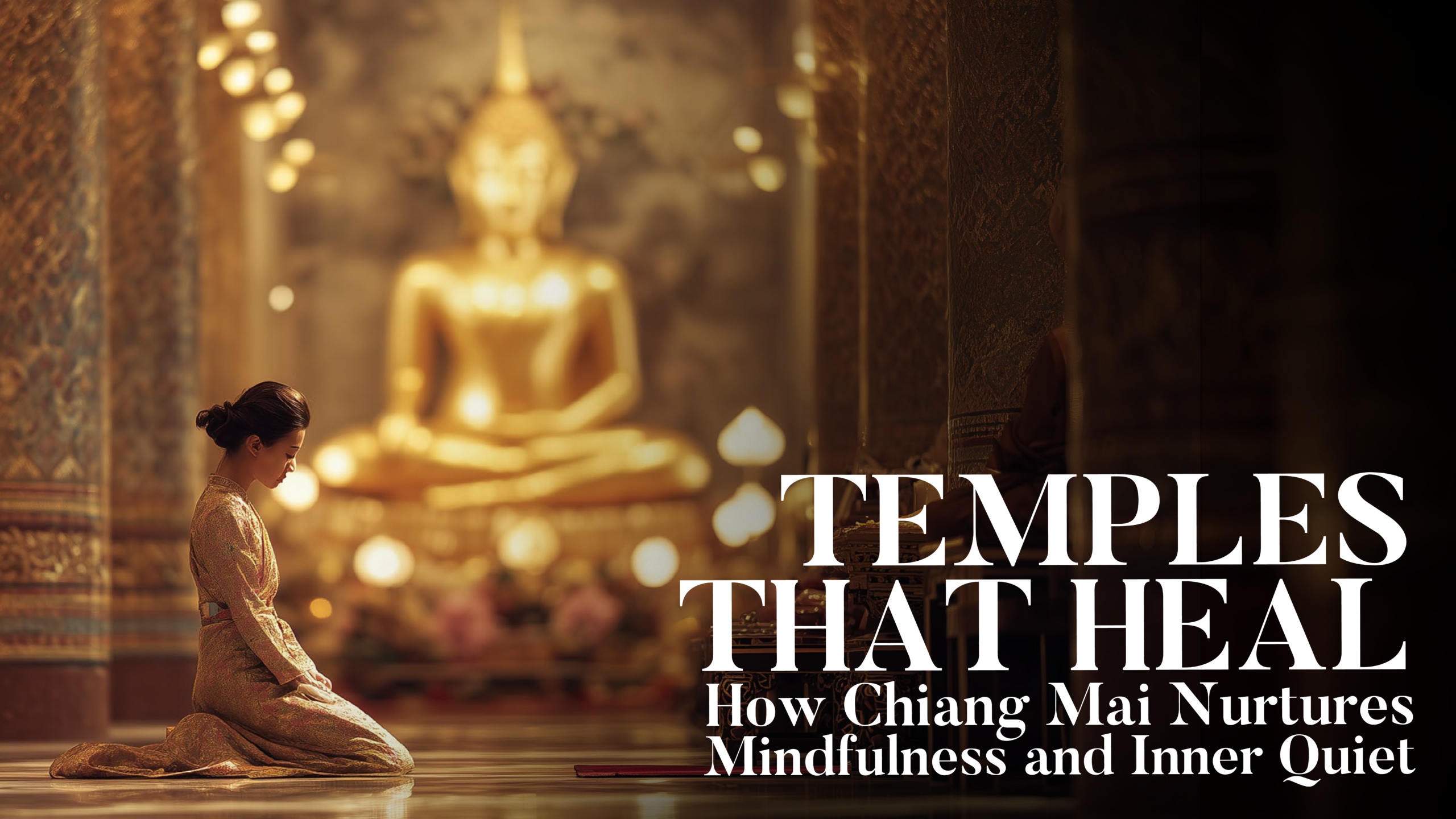
Perhaps nowhere is this blend of sacred geography and natural calm more powerful than Doi Suthep, the iconic mountaintop overlooking the city. The ascent up winding roads gradually reveals sweeping views of the valley below. At the summit sits Wat Phra That Doi Suthep, one of Thailand’s most revered temples. With golden chedis that catch early sunbeams and courtyards scented with incense, it creates an emotional atmosphere that is at once humbling and uplifting. Many travellers describe sunrise at Doi Suthep as a moment when the world quiets down long enough for them to hear themselves again.
Beyond this famous peak lie other sanctuaries: lush national parks, forest monasteries connected by meditative walking trails, and mountain villages where life unfolds at a pace unchanged for generations. Walking through these landscapes during the monsoon, when rain polishes leaves into emerald glass and fog hangs low over the ridges, feels like stepping into a world built entirely for introspection.
What sets Chiang Mai apart as a healing destination is how seamlessly mindfulness integrates into everyday life. This is not a city where meditation is practised solely in retreat centres. It’s in the way locals offer flowers at a shrine before beginning work, in the monk-led chanting that echoes softly from temple halls, and in the attention to detail with which artisans carve wooden sculptures or stitch traditional textiles.
That said, Chiang Mai is also home to some of the region’s most respected places for formal practice. Wat Umong, a centuries-old forest temple with mossy tunnels and towering trees, is ideal for those seeking quiet reflection. More advanced practitioners often journey farther outward to forest monasteries like Wat Pa Tam Wua, which offer silent Vipassana retreats. Here days unfold in simple patterns: sitting meditation, walking meditation, chanting, mindful meals. It is not an escape from life but an invitation into its essential clarity.
Visitors often describe these experiences as “reset buttons.” The absence of digital noise, combined with the compassionate guidance of monks, helps them reconnect with thoughts and emotions long ignored. It is a gentle reset, not dramatic, not forced, but deeply restorative.
Healing in Chiang Mai is not limited to the inner world; it extends to the body through centuries-old therapeutic traditions. Lanna healing systems, influenced by Thai, Burmese and indigenous highland knowledge, emphasise balance, warmth and herbal nourishment.
The city’s herbal spas are renowned globally, and not without reason. Treatments incorporate lemongrass, ginger, camphor, wild turmeric and locally grown herbs that are steamed, pressed or brewed to ease tension. The traditional herbal compress massage, a signature Lanna therapy, uses cloth pouches filled with warm herbs, applied rhythmically along energy lines of the body. The effect is both grounding and rejuvenating, a tactile complement to the city’s spiritual calm.
Many spas also offer steam rituals in small wooden chambers infused with medicinal leaves. It’s a sensory experience, fragrant, warm, almost womb-like, that encourages profound relaxation. Combined with the city’s slower pace, these therapies create a holistic healing environment where body and mind feel equally nurtured.
Chiang Mai rewards those who slow down long enough to absorb its nuances. The best way to experience the city is not through a checklist of attractions but through immersion. Spend a morning wandering hidden temples in the old city, each with its own personality, some ornate, others humble. Sit quietly during a monk-led meditation, allowing the cadence of chanting to settle into your breath. Take an unhurried tuk-tuk ride into the countryside and walk through monsoon-fed forest trails. Sip tea in a riverside café as rain taps softly on bamboo roofs.
This is a destination that heals not through spectacle but through presence. Its gifts are subtle: a warm smile from a monk, the earthy scent after rainfall, the way mountain mist wraps the city like a shawl. These are the moments that linger long after the trip ends.
As Chiang Mai’s popularity grows, responsible engagement becomes crucial. Temples are active sites of worship, not photo sets. Visitors should dress modestly, speak softly and follow monastic guidelines. When participating in meditation retreats, it’s important to honour rules of silence, device restrictions and mindful conduct.
Supporting local artisans, healers and community-based initiatives also helps preserve Lanna culture. Whether it’s purchasing handmade textiles, attending a local craft workshop or choosing eco-conscious retreats, travellers contribute to the cultural continuity that makes Chiang Mai special.
In an overstimulated world where silence feels rare and inner clarity rarer still, Chiang Mai stands as a quiet oasis. Its temples offer stillness, its monks offer guidance, its forests offer shelter, and its people offer warmth. But perhaps its greatest gift is the permission it gives visitors to pause, to step outside their mental noise and rediscover a gentler rhythm of being.
Chiang Mai doesn’t transform you dramatically in a single moment. Instead, it heals in small, patient ways: through golden temple light, through mindful breath, through the earthy perfume of monsoon rain. It doesn’t demand anything from you, not speed, not performance, not perfection. It simply invites you to come as you are and leave a little lighter.