
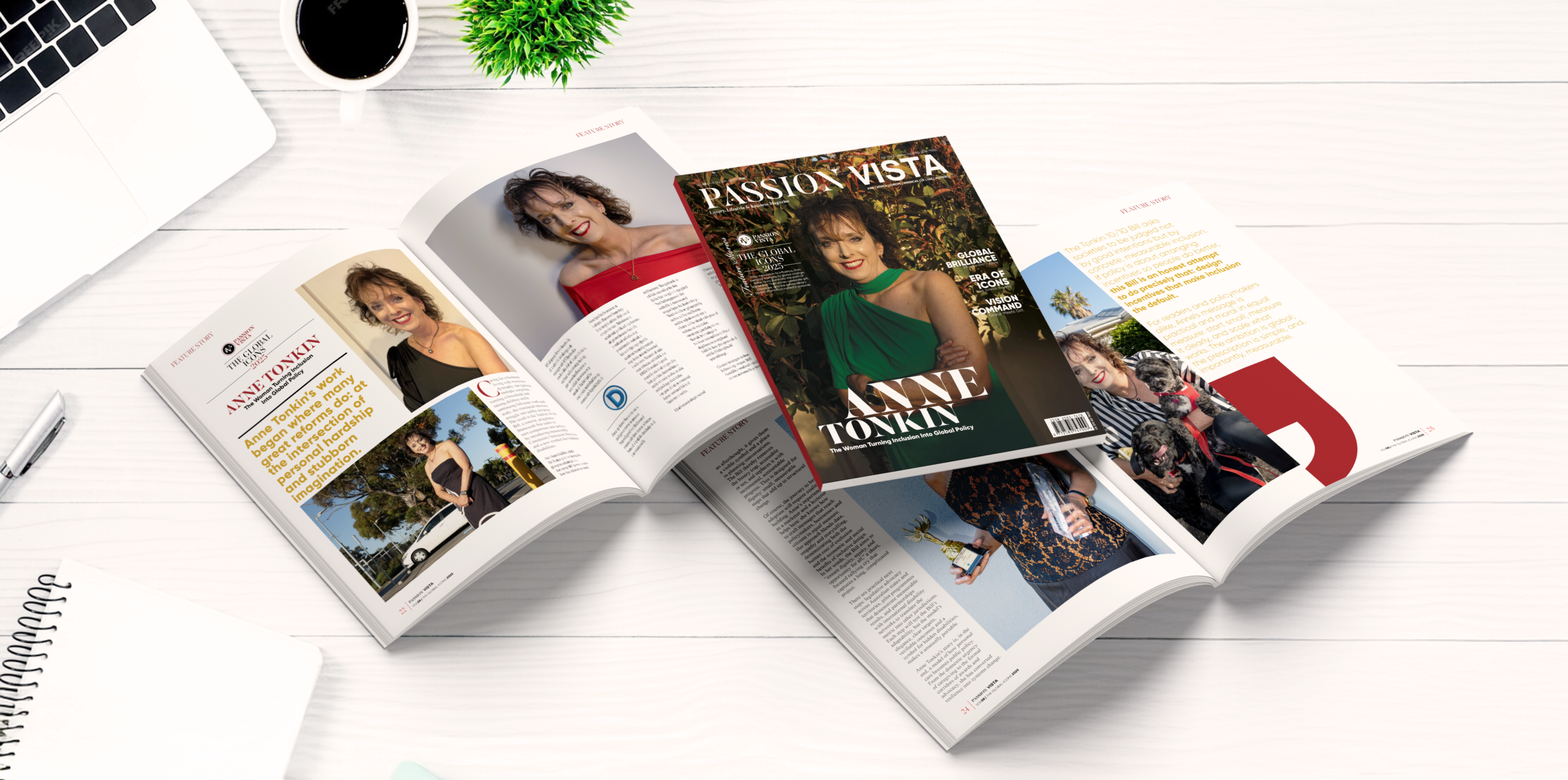

Anne Tonkin’s work began where many great reforms do: at the intersection of personal hardship and stubborn imagination. Caring for a husband living with myotonic dystrophy, navigating multiple surgeries, running a household and raising children while continuing full-time work and study, she translated intimate struggle into public purpose. The result is the Tonkin 10/10 Bill, a concise, pragmatic framework that seeks to turn compassion into policy by introducing measurable Community Inclusion Metrics and a new symbol for hidden disabilities.
At its heart the Tonkin 10/10 Bill is deceptively simple. It proposes clear targets, for example, 10% provision for wheelchair users and 10% for people with mobile disabilities, alongside a recognisable “D” symbol for mobile/hidden disabilities, so that inclusion stops being guesswork and becomes a verifiable community standard. The clarity of the metrics is tactical: by defining measurable goals, the Bill forces planners, businesses and governments to move beyond goodwill and toward measurable outcomes that can be audited, scaled and adopted internationally.
Anne’s path to this moment is shaped by more than policy literacy; it is defined by lived experience. She balances academic depth, five diplomas, a degree and a master’s, with two decades of industry practice and two decades lecturing, bringing both academic theory and practical implementation to the work of inclusion. Those credentials matter because the Tonkin 10/10 Bill is not a feel-good manifesto: it is designed to be legislated across all states and territories in Australia and packaged so it can be integrated into international frameworks and United Nations networks.
Her advocacy is also personal and humane. She speaks often of the lessons from her late father, “never giving up” and “be the change you wish to see,” and lets humour and empathy steer her leadership. “I lead with integrity, empathy, and resilience,” she says, and her style demonstrates that resilient leadership need not be austere; it can be warm, strategic and adaptive. Short daily rituals, a spin bike session, walks with her dogs, the occasional glass of bubbles, keep her grounded and fuel the long haul of systemic change.
Concrete recognition has a following-impact. In 2025 Anne Tonkin was a finalist and winner across multiple awards that recognised social impact and disability inclusion, from regional APAC accolades to global leadership honours. These honours are not merely personal trophies; they are validation that a standards-based approach to inclusion can attract mainstream institutional support and media attention, a necessary precondition for scaling reforms.
The genius of the Tonkin 10/10 Bill lies in how it reframes the question of accessibility. Instead of asking whether a place is “accessible” in broad strokes, it asks: does this community meet a measurable share of needs? Instead of treating hidden disabilities as an afterthought, it gives them a visible symbol and a place in planning conversations. The Bill thereby removes the binary trap, accessible or not, and replaces it with incremental, accountable progress. This is designed for dignity: small, measurable steps that add up to structural change.
Of course, the journey to broad adoption will require coalition building. Anne’s experience as a marketer and a lecturer helps here: she knows how to craft messages that reach policymakers, businesses and citizens in equal measure. Her approach blends data, empathy and storytelling, demonstrating both the human cost of exclusion and the economic and social benefits of inclusive design. In her words, the Bill aims to “ensure dignity, equity, and opportunity for all,” a short, focused rallying cry that captures a long, complicated project.
There are practical next steps: legislative advocacy across Australian states and territories, pilot programmes that demonstrate measurable results, and partnerships with international disability networks to translate the metric into other jurisdictions. Each step will test the Bill’s adaptability, but the model’s elegance, clear targets, verifiable outcomes and a symbol for hidden disabilities, makes it unusually portable.
Anne Tonkin’s story is, in the end, a model of how personal care becomes public policy. From the domestic urgency of caregiving to the formal corridors of awards and advocacy, she has converted resilience into systems change. The Tonkin 10/10 Bill asks societies to be judged not by good intentions but by concrete, measurable inclusion. If policy is about arranging incentives so people do better, this Bill is an honest attempt to do precisely that: design incentives that make inclusion the default.
For readers and policymakers alike, Anne’s message is practical and moral in equal measure: start small, measure it clearly, and scale what works. The ambition is global; the prescription is simple, and, importantly, measurable.


