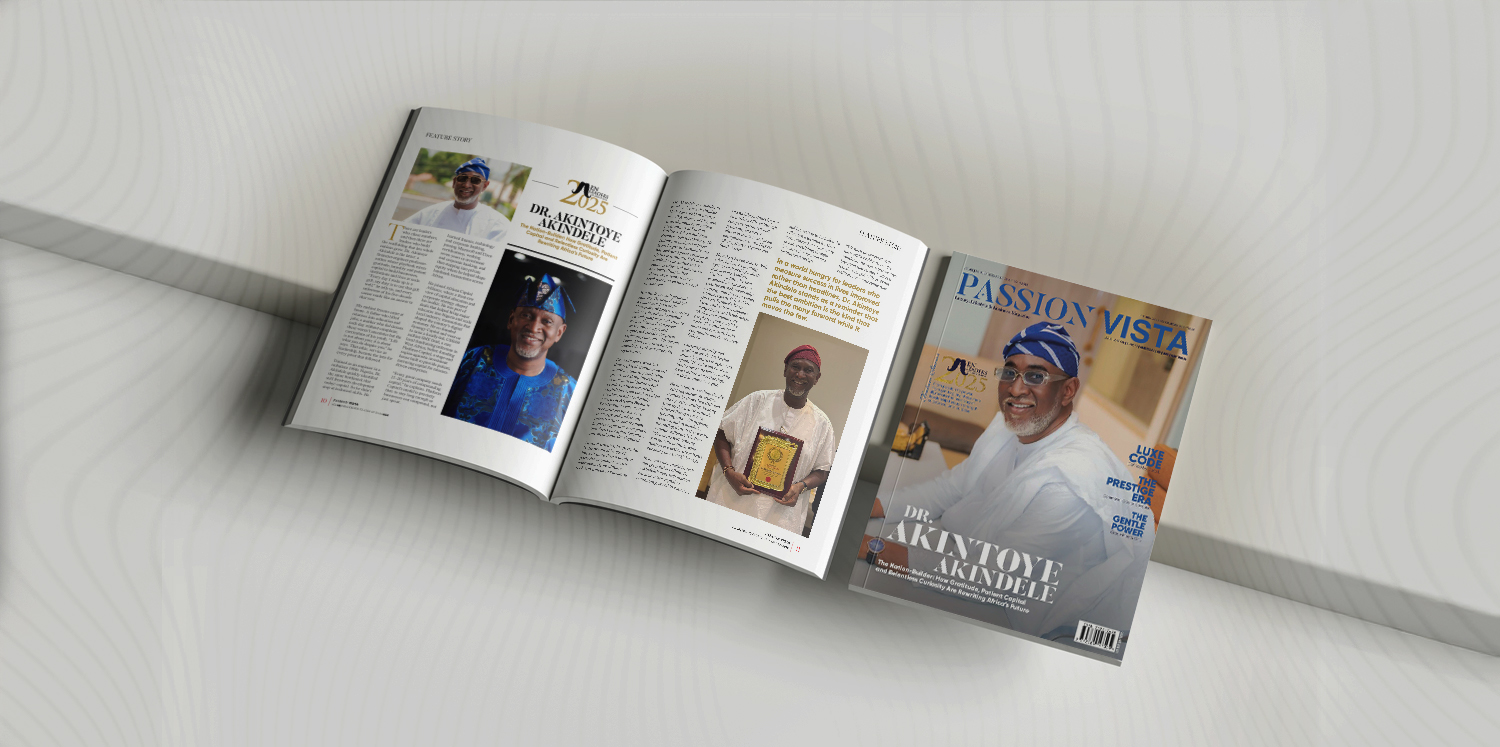

The Nation-Builder: How Gratitude, Patient Capital and Relentless Curiosity Are Rewriting Africa’s Future
There are leaders who chase numbers, and then there are leaders who build the scaffolding that lets whole nations grow. Dr. Akintoye Akindele is the latter: a financier-engineer-professor-author whose playbook mixes gratitude, humility and patient capital to build businesses, institutions and lives at scale. “Every day I wake up is a gift, my duty is to use that gift well,” he tells us, and every milestone of his five-decade career reads like an answer to that vow.
His earliest lessons came at home. A father who lifted relatives into education and jobs; a mother who fed dozens each day without complaint, these weren’t anecdotes but the curriculum of his youth. “Life is not about you; it is about what you do despite you,” he says. That ethic, service as leadership, became the lens for every pivot that followed.
Trained as an engineer in a turbulent 1990s Nigeria, Dr. Akindele quickly identified the same bottleneck that still frustrates development today: capital. So he didn’t stop at technical skills. He learned finance, technology and corporate banking, passing Microsoft and Cisco certifications, working seven years in investment and corporate banking, and then stepping into private equity where he helped shape landmark transactions across Africa.
He joined African Capital Alliance, where a front-row view of capital allocation and corporate strategy shaped his toolkit. He was part of deals that helped bring major telecoms into Nigeria and scale local industry, transactions that shaped the country’s digital economy. He co-founded Synergy Capital and went on to raise a locally-led, US$100 million SME fund, a rare local fundraising milestone in West Africa, before founding Platform Capital, a stage-and region-agnostic investment house built to provide patient, nurturing capital for mission-driven enterprises.
“Every great company needs 15–20 years of compounding capital,” he explains. Platform Capital’s model is precisely that: to stay long enough so businesses can compound, not just sprint.
Dr. Akindele is a scholar as much as he is a dealmaker. He holds a PhD in finance, is a CFA charter holder, and is an alumnus of executive programmes at London Business School and Said Business School (Oxford). He lectures at business schools, from Lagos to Normandy and has delivered guest sessions at global institutions. He’s also credited as an author and, by public profiles and interviews, as a bestselling author whose work spans finance, developmental economics and investment.
But his focus isn’t personal renown. He helped establish a business school at the University of Lagos, renovated science faculties, incubated ed-tech platforms and climate-tech solutions that convert waste into energy, and supported social enterprises replacing charcoal with cleaner fuels. These are investments intended as infrastructure for opportunity.
Dr. Akindele’s work has drawn global attention: award citations, industry leadership prizes, speaking invitations at international forums, and profiles in business media. Highlights often cited in public profiles include leadership awards at African Business Leadership events, sector recognitions for his work in energy and midstream infrastructure, and frequent keynote appearances on panels that focus on capital formation and sustainable development.
Beyond trophies, his portfolio is the practical badge of impact: more than a hundred portfolio companies across continents (from climate tech and fintech to education and mobility), direct impact on millions of lives through company operations and programs, and active efforts to incubate and scale entrepreneurs across Nigeria, Ghana, Kenya, Uganda and South Africa.
How does he run teams? With a flat, inclusive operating system anchored by a single test: service. Platform Capital’s culture, he says, is defined by transparency (significant staff ownership), empathy, and five core values summarized as B-L-A-C-K: Be-Your-Brother’s-Keeper, Love, Authenticity, Capacity (competence) and Knowledge. “A rich man among poor people is a poor man,” he notes. The implication is moral and practical: build community and the economy follows.
Curiosity, humility and gratitude are the leadership pillars he returns to again and again. “If you’re not curious, you’re dead,” he warns, and he treats failure as a reframing, not defeat unless you quit.
He unwinds by reading, deeply watching stories (he studies creators in shows like Billions) and by water: sailing, boating, time by the sea. He grounds himself through service, spending time with orphans, widows, and in hospitals, reminding himself that wealth without wellbeing is hollow. “You come with nothing, you go with nothing, what matters is whether life is better because you existed,” he says.
In an era when markets, tech and geopolitics collide, Dr. Akindele’s approach matters because it ties capital to community, speed to patience, and innovation to inclusion. He offers not a formula for short-term returns but a case study in nation-building through investment, education and institutional design.
“We must be obsessed with the world’s problems, not the solutions,” he says, a provocative inversion that pushes leaders to remain engaged with evolving realities, not comfortable fixes.
In a world hungry for leaders who measure success in lives improved rather than headlines, Dr. Akintoye Akindele stands as a reminder that the best ambition is the kind that pulls the many forward while it moves the few.